The Complete Peptide Protocol Guide

Everything you need to start, track, and optimize your peptide journey — from choosing your first peptide to advanced protocols. Everyone has an opinion about peptides. Almost nobody has the receipts. What follows sets the guide’s six chapters beside the record they are drawn from: the regulation, the money, the demand, the supply integrity, and the evidence — with the weak data labeled in place.
What’s Inside the Guide
Peptide Basics: what peptides are, how they work, and how they differ from steroids and hormones. Peptide Rankings 2026: S-tier to C-tier breakdown of the most popular peptides with evidence-based analysis. Reconstitution Guide: step-by-step instructions for mixing peptides with bacteriostatic water, including the math.
Dosing Protocols: goal-specific protocols for fat loss, healing, GH optimization, and anti-aging. Safety Guidelines: side effects to watch for, when to stop, and how to source quality peptides. FAQ & Next Steps: answers to the most common beginner questions and how to get started.
A category mid-reversal.
The moment in numbers. Six of seven peptides were recommended by the FDA advisory panel; none of the seven were recommended by FDA’s own scientific reviewers. 6,441 consumer-marketed samples were independently tested, and between 41.6% and 71.1% failed basic quality criteria across two models, with 15% carrying measurable bacterial endotoxin. Worldwide monthly searches for “peptides” now run at roughly 8M. Published BPC-157 pilot studies total 30 participants between them. And 55% of active Peptide Prime logging was retatrutide alone.
These figures are reported by the cited sources and have not been independently audited by Peptide Prime. Conflicts are shown, not polished away.
Four forces. One record.
Inside the report: a category-wide view for people making personal, clinical, commercial, editorial, or investment decisions—without pretending those decisions are the same. Four forces are followed separately, and the same behavioural record sits under all of them.
The reversal was real. Legal clarity was not.
01 — Regulation. A two-day advisory vote recommended six compounds for the 503A bulks list. The report separates three events the market keeps collapsing into one: removal from Category 2, an advisory recommendation, and final rulemaking. 8–6–1 — the vote on BPC-157, KPV, and TB-500.
Follow manufacturing capacity, not the loudest feed.
02 — Money. Market estimates vary by more than 3×, but the underlying capital is less ambiguous: Samsung Biologics is acquiring PolyPeptide for $1.81B while Bachem and CordenPharma expand synthesis capacity. $1.81B — the Samsung Biologics / PolyPeptide transaction.
Demand went vertical before policy moved.
03 — Demand. Worldwide monthly Google searches for “peptides” rose from roughly 1.3 million in 2024 to around 8 million in 2026. The report maps the microphones, workarounds, and trust shift behind the curve. 6.2× — two-year growth across measured anchor points.
Thirty people and ten thousand people are not one category.
04 — Evidence. BPC-157’s published human evidence totals three pilot studies and thirty participants. One ongoing retatrutide cardiovascular outcomes trial targets 10,000. A logarithmic view makes the evidence gap legible. 333× — the difference between 30 and 10,000 participants.
What is actually in the vial?
The buried story. Independent analysis of 6,441 consumer-marketed samples found between 41.6% and 71.1% failed basic quality criteria. Fifteen percent carried measurable bacterial endotoxin. Broken out by compound, the TB-500 sample pass rate was 7.5% and the retatrutide sample pass rate was 47.0%.
The cited 2026 analysis is a preprint and has not completed peer review. The report labels that limitation alongside the finding.
The category has opinions. It needs a record.
Regulators voted without a behavioral record. Clinics assign protocols without one. People run twelve-week cycles from memory. Peptide Prime exists to document what happens over time.
74% of long-term users change their active stack month to month. 83% of logged injections are single-compound, despite stack culture online. 93% of TB-500 loggers also track BPC-157—the Wolverine pairing is visible. Peptide Prime takes no vendor, clinic, or sponsor money and runs no affiliate links.
How we grade claims
Peptide Prime scores statements, not people. Leaderboards aggregate claim-level evidence grades so the public can see patterns — with sources, limitations, and a path to correct mistakes.
Pipeline
Ingest a public Instagram, Reddit, or caption link (transcript + caption when available). Extract discrete peptide-related claims with an LLM. Retrieve supporting or contradicting literature (PubMed, Europe PMC, Semantic Scholar, ClinicalTrials.gov). Assign a verdict per claim and reconcile an overall post verdict. Publish a shareable report with citations. Account scores update from claim tallies.
Three narrative buckets
Charts group the four verdicts into a story people can share: what is backed, what is wrong, and what is grey — like animal data presented as human fact.
Evidence-based: supported claims that match published evidence at the stated strength. Factually incorrect: misleading claims that conflict with evidence or invent certainty. Grey / overstated: overstated or no-evidence claims — e.g. “BPC-157 fixes Achilles” from rat tendon models, not proven human Achilles repair trials.
Verdict definitions
Supported — claim aligns with published evidence at the stated strength. Overstated — direction may be plausible, but magnitude, certainty, or audience framing exceeds the evidence. Misleading — claim conflicts with evidence or omits critical safety/context in a way that misleads. No Evidence — we could not find adequate published support for the claim as stated.
Evidence sources
PubMed / MEDLINE — 35M+ biomedical articles. Europe PMC — preprints + open access. Semantic Scholar — AI academic graph. ClinicalTrials.gov — human trial registry.
Leaderboard math
Science credibility score = (Supported + 0.5 × Overstated) ÷ total claims × 100. Accounts need at least 3 audited claims to appear on public boards. Labels use evidence-grade language (“High evidence grade”), never insults or fraud accusations.
Inclusion on the priority watchlist is not an endorsement or accusation — it is a backlog of high-reach peptide voices we want to audit fairly.
Limitations
Science evolves; older citations may be superseded. Transcripts and captions can miss context, sarcasm, or disclaimers. AI extraction can err — humans can request review via Right of Reply. Not medical advice. Educational use only.
Where to go next
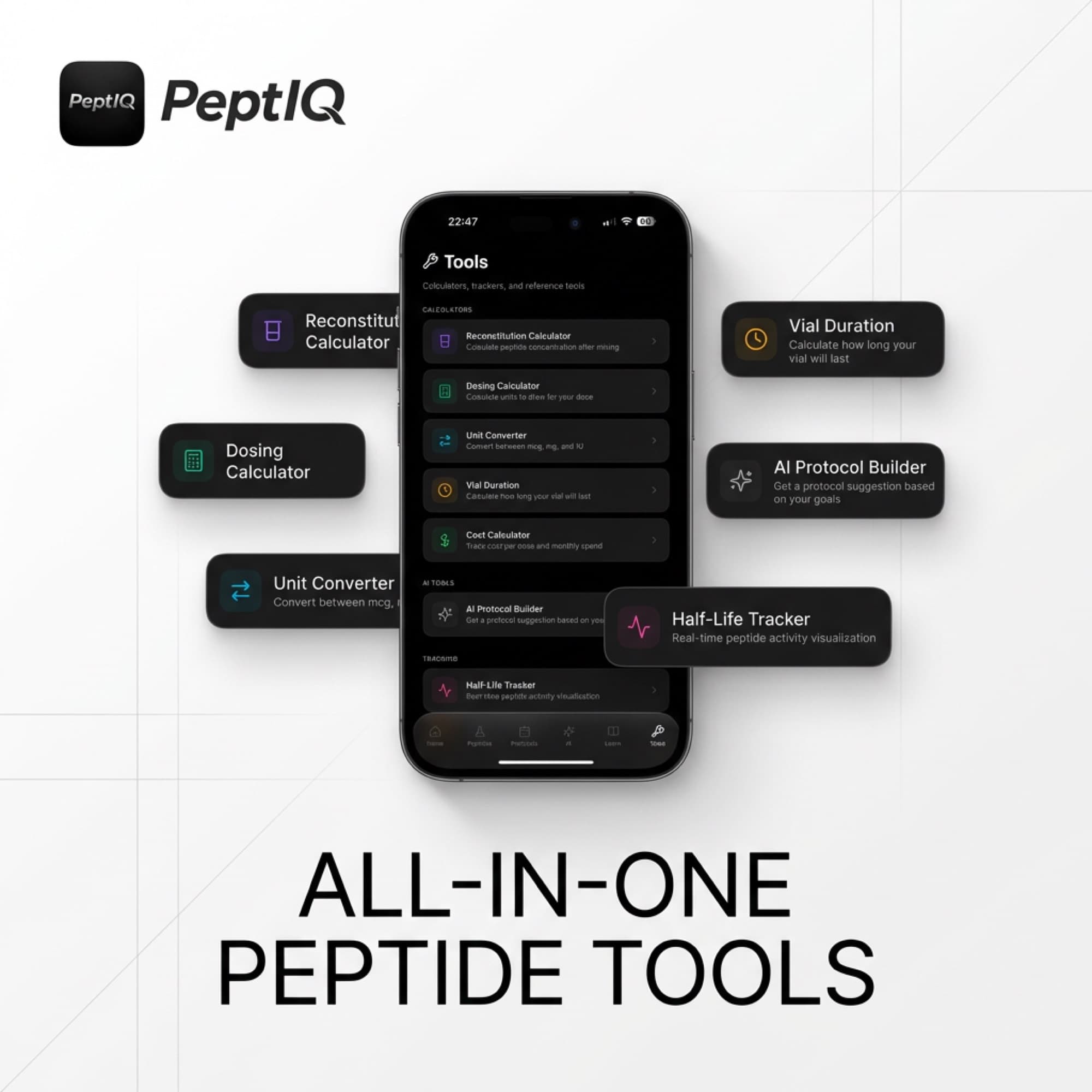
Explore topical clusters for peptide calculators, research education, app comparisons, and protocol tracking workflows. Peptide Calculators: reconstitution, dosage, conversion, and vial planning guides. Peptide Research: research-oriented references, education, and workflow guides. Peptide Apps: tracker app comparisons and app selection frameworks. Protocol Tracking: scheduling and protocol consistency resources.
Every guide should be cross-checked against regulatory and clinical primary sources: FDA Drug Information, the Drugs@FDA database, ClinicalTrials.gov, and a PubMed peptide search.
Read the receipts.
26 pages. 50+ cited sources. Clear distinctions between primary evidence, institutional analysis, directional estimates, and Peptide Prime’s own anonymized first-party data. Informational only. Not medical advice. No vendor funding.
Disclaimer: This guide is educational and informational. It does not recommend using, buying, prescribing, starting, stopping, or changing any compound. Not medical advice. Educational use only.